

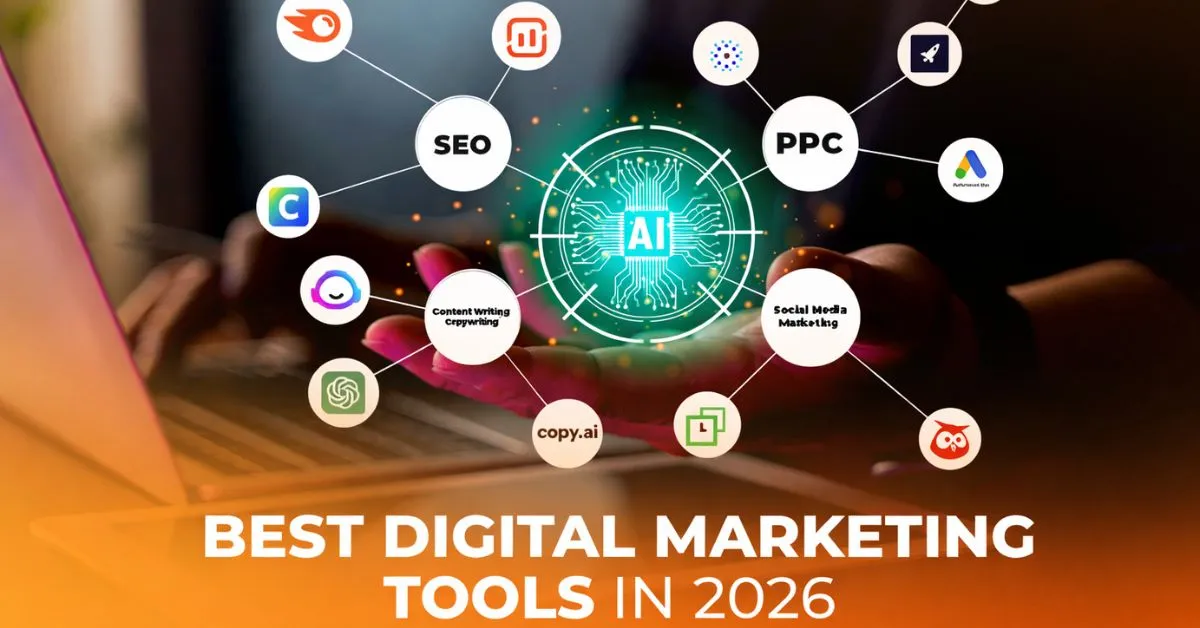
Modern marketing depends heavily on technology, automation, and data insights. Businesses today cannot compete effectively without using the right systems to manage campaigns, analyze audience behaviour, and optimize performance. This is where Digital Marketing Tools become essential for marketers, entrepreneurs, and organisations of all sizes.
From search engine optimization and advertising platforms to email automation, analytics, and design software, these tools help streamline operations and improve results. They allow teams to plan strategies faster, execute campaigns more efficiently, and measure outcomes accurately across multiple channels.
This guide covers the best Digital Marketing Tool in 2026, including both free and paid solutions that support traffic growth, lead generation, customer engagement, and business scalability.
Best Digital Marketing Tools: 2026 List
Below is a curated list of top tools across multiple categories used by professionals worldwide.
| Category | Purpose | Best For | Example Use |
| Digital Marketing Tool for SEO | Improve search visibility | Bloggers & businesses | Keyword optimization |
| Content Creation Tools | Create content and visuals | Creators & marketers | Blog writing & graphics |
| Social Media Tools | Manage social platforms | Agencies & brands | Post scheduling |
| Automation Tools | Automate workflows | Businesses | Email sequences |
| Analytics Tools | Measure performance | Professionals | Conversion tracking |
Digital Marketing Tools for Advertising
1. Google Ads
Google Ads is one of the most widely used online advertising platforms that helps businesses reach potential customers through search, display, video, and shopping ads. It allows marketers to target users based on keywords, location, device, and audience behaviour, making campaigns highly precise and performance-driven.
Businesses use Google Ads to generate leads, increase website traffic, and drive sales quickly because ads appear when users are actively searching for products or services. With proper optimization, it delivers measurable ROI and scalable growth.
Key Features & Benefits:
- Search, display, and video advertising
- Keyword and audience targeting
- Budget control and bidding strategies
- Conversion tracking and analytics
- Remarketing capabilities
2. Meta Ads
Meta Ads enables businesses to advertise across Facebook, Instagram, Messenger, and Audience Network. It is especially effective for brand awareness, engagement campaigns, and eCommerce promotions due to its strong visual formats.
The platform offers advanced targeting options based on demographics, interests, and user behaviour, allowing businesses to reach highly relevant audiences. Marketers widely use Meta Ads for lead generation and customer acquisition campaigns.
Key Features & Benefits:
- Advertising across Facebook and Instagram
- Interest and behavior-based targeting
- Visual ad formats like reels and stories
- Custom and lookalike audiences
- Detailed campaign performance insights
Digital Marketing Tool for SEO
3. Google Search Console
Google Search Console is a free tool that helps website owners monitor and maintain their presence in Google search results. It provides data about search performance, indexing status, and technical issues that affect visibility.
Marketers use it to track keyword rankings, fix crawl errors, submit sitemaps, and improve overall SEO performance. It acts as a foundation for understanding how Google views a website.
Key Features & Benefits:
- Search performance reports
- Indexing and crawl monitoring
- Sitemap submission
- Mobile usability insights
- Technical SEO alerts
4. Ahrefs
Ahrefs is a powerful SEO tool used for backlink analysis, keyword research, and competitor insights. It is known for its large backlink database and accurate metrics that help marketers understand ranking factors.
Businesses use Ahrefs to analyze competitor strategies, identify link-building opportunities, and monitor search rankings. It is especially useful for content marketing and SEO campaigns focused on organic growth.
Key Features & Benefits:
- Backlink analysis database
- Keyword difficulty and search volume data
- Competitor research tools
- Rank tracking features
- Technical SEO audits
5. SEMrush
SEMrush is an all-in-one marketing platform that supports SEO, PPC research, and competitive analysis. It helps marketers understand traffic sources, keyword opportunities, and advertising strategies.
The tool is widely used by agencies and businesses managing multiple campaigns because it combines search marketing data with content insights in one dashboard.
Key Features & Benefits:
- Comprehensive keyword research
- SEO audit tools
- Competitor analysis
- PPC campaign research
- Content optimization suggestions
Digital Marketing Tools for Social Media
6. Buffer
Buffer is a social media scheduling and management tool designed to help businesses maintain consistent posting across platforms. It provides a simple dashboard to plan, publish, and analyze content performance.
It is particularly useful for small businesses, creators, and marketers who want efficient social media management without complex systems.
Key Features & Benefits:
- Post scheduling and automation
- Content calendar planning
- Multi-platform publishing
- Performance analytics
- Easy-to-use interface
Digital Marketing Tools for CRM & Email Marketing
7. HubSpot
HubSpot is a comprehensive platform that combines CRM, email marketing, automation, and analytics. It allows businesses to manage customer relationships and track marketing performance from one place.
Marketers use HubSpot to nurture leads, automate workflows, and align marketing with sales activities, making it ideal for growth-focused companies.
Key Features & Benefits:
- CRM and contact management
- Email automation workflows
- Lead tracking and scoring
- Marketing analytics dashboards
- Sales integration tools
8. Mailchimp
Mailchimp is a popular email marketing platform used to create and manage email campaigns, newsletters, and automation workflows. It helps businesses communicate with customers and build long-term relationships.
Its beginner-friendly interface makes it suitable for small businesses and startups starting with email marketing.
Key Features & Benefits:
- Drag-and-drop email builder
- Audience segmentation
- Automation workflows
- Campaign analytics
- A/B testing features
Digital Marketing Tools for Analytics & Performance
9. Google Analytics
Google Analytics is a powerful analytics tool that tracks website traffic, user behaviour, and conversions. It helps businesses understand how visitors interact with their websites and marketing campaigns.
Marketers rely on it to optimize campaigns, improve user experience, and make data-driven decisions.
Key Features & Benefits:
- Website traffic tracking
- User behaviour insights
- Conversion analysis
- Audience reports
- Campaign performance tracking
Design & Creative Tools for Marketing
10. Canva
Canva is a graphic design tool that enables users to create marketing visuals quickly using templates and drag-and-drop features. It is widely used for social media content, ads, and presentations.
Businesses prefer Canva because it eliminates the need for advanced design skills while maintaining professional quality.
Key Features & Benefits:
- Ready-made templates
- Drag-and-drop editor
- Brand kits
- Stock images and icons
- AI design tools
Website & E-commerce Tools
11. WordPress
WordPress is the most widely used content management system for creating websites and blogs. It allows businesses to publish content, manage pages, and integrate marketing tools easily.
Its flexibility and plugin ecosystem make it suitable for both small websites and large platforms.
Key Features & Benefits:
- Easy content management
- SEO-friendly structure
- Thousands of plugins
- Custom themes
- Scalable architecture
12. Shopify
Shopify is a leading e-commerce platform that helps businesses create online stores without technical complexity. It supports product management, payments, and marketing integrations in one system.
It is widely used by online brands and entrepreneurs to sell products globally.
Key Features & Benefits:
- Online store builder
- Secure payment system
- Marketing integrations
- Analytics dashboards
- Scalable infrastructure
Free vs Paid Digital Marketing Tools
Choosing between free tools and paid solutions depends on business needs, budget, and growth stage.
Free Tools – Advantages
- Ideal for beginners and startups
- No financial investment required
- Good for learning marketing fundamentals
- Suitable for small campaigns
Paid Tools – Advantages
- Advanced features and automation
- More accurate data insights
- Better integrations with other systems
- Scalability for growing businesses
Most businesses start with free tools and gradually move to paid solutions as they expand.
How Digital Marketing Tools Improve Marketing Strategies
The right tools do more than just automate tasks; they improve overall marketing strategies by providing actionable insights.
For example, competitor analysis tools allow marketers to understand what works in their industry. Website audit tools help identify technical errors that affect search rankings. Automation tools streamline customer communication, ensuring faster response times and better user experiences.
When tools are integrated properly, explore the best digital marketing tool in 2026 for SEO, ads, social media, email, and analytics. Compare free and paid tools to grow traffic and conversions. Businesses can create a complete ecosystem that supports every stage of the marketing funnel from awareness to conversion and retention.
Key Features to Look for in Digital Marketing Tools
Choosing the right tools requires careful evaluation. Some important features include:
- User-friendly interface for easy adoption
- Automation capabilities to save time
- Integration options with existing systems
- Real-time analytics and reporting
- Scalability for future growth
- Customer support and training resources
A tool that lacks usability or integration can create more problems than benefits.
Benefits of Using Digital Marketing Tool
Better Time Management
Automation reduces manual workload, allowing teams to focus on creativity and strategic planning rather than repetitive tasks.
Data-Driven Decisions
Analytics dashboards provide measurable insights, helping marketers make informed decisions instead of relying on assumptions.
Higher Return on Investment
Optimized campaigns lead to improved conversions, reducing wasted marketing budgets.
Improved Customer Targeting
Advanced segmentation helps businesses deliver personalized messages to the right audience at the right time.
Consistent Brand Presence
Scheduling tools ensure brands remain active and visible across multiple platforms without interruption.
Digital Marketing Tools for Small Businesses
Small businesses often operate with limited budgets and resources. Fortunately, many free tools are available that provide powerful functionality.
Here is a useful overview:
| Tool Type | Suitable For | Cost Level | Key Benefit |
| Free Tools | Beginners | Low | Learning & experimentation |
| Automation Tools | Growing businesses | Medium | Efficiency improvement |
| Analytics Tools | Professionals | Medium | Performance tracking |
| Premium Tools | Agencies | High | Advanced insights |
Small businesses should focus on tools that provide maximum value without unnecessary complexity.
How to Choose the Right Digital Marketing Tool in 2026
Selecting the right tools requires strategic thinking. Businesses should consider the following factors:
First, they should define their marketing goals clearly. Whether the objective is lead generation, brand awareness, or sales growth, tools should align with those goals.
Second, they must evaluate budget constraints. Expensive tools do not always guarantee better results. Sometimes simple solutions are more effective.
Third, integration capabilities should be considered. Tools that connect with existing systems improve workflow efficiency.
Finally, scalability is crucial. A tool should be able to support business growth over time.
Future Trends in Digital Marketing Tools
Technology continues to reshape digital marketing. Several trends are expected to dominate in the coming years:
- Artificial intelligence for predictive analytics
- Voice search optimization tools
- Advanced automation workflows
- Personalized marketing experiences
- Privacy-focused data tracking solutions
Marketers who adopt new technologies early will gain a strong competitive advantage.
Conclusion
In 2026, marketing success depends heavily on technology adoption. Businesses that leverage the right Digital Marketing Tools can improve efficiency, enhance customer engagement, and achieve measurable growth.
From automation tools and analytics platforms to content creation solutions and website audit tools, each category plays a unique role in building successful marketing strategies. Free tools provide a great starting point, while paid solutions offer advanced features for scaling businesses.
Ultimately, the best approach is to choose tools that align with business goals, budget, and long-term vision. When used effectively, these tools become powerful assets that drive sustainable growth and competitive advantage in the digital marketplace.
FAQs
1. What are Digital Marketing Tools, and why are they important?
Digital Marketing Tool help businesses manage campaigns, analyze data, automate tasks, and improve online visibility, making marketing more efficient and results-driven.
2. Are free tools effective for beginners?
Yes, many free tools provide essential features that help beginners learn marketing strategies and run basic campaigns without financial investment.
3. How do automation tools improve marketing performance?
Automation tools save time by handling repetitive tasks such as email sequences, lead nurturing, and scheduling, allowing marketers to focus on strategy.
4. What are website audit tools used for?
Website audit tools analyze technical performance, SEO issues, and user experience problems to improve search rankings and conversions.
5. How do competitor analysis tools help businesses?
Competitor analysis tools provide insights into competitor strategies, keywords, and content performance, helping businesses identify growth opportunities.
6. Which online marketing tools are best for content creation?
Many online marketing tools help create content such as blog posts, visuals, and videos, making content production faster and more efficient.