
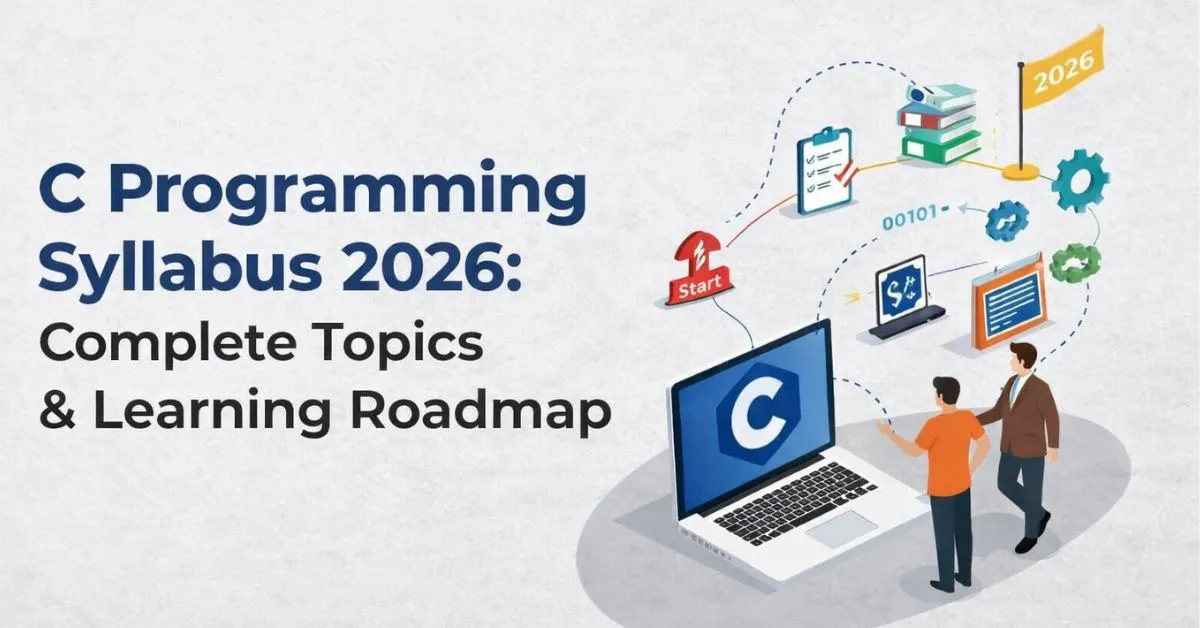
C programming is one of the most influential and widely taught programming languages in the world of computer science. Known for its speed, flexibility, and ability to directly interact with system memory, C remains a core subject for students and developers even in 2026. From creating small console programs to building complex operating systems, C provides the foundation required to understand how software works at a deeper level.
This comprehensive C programming syllabus is designed to help learners progress step by step, starting with basic programming concepts and gradually moving toward advanced topics. The curriculum focuses on both theoretical understanding and practical implementation so that learners can build strong technical skills for real-world software development.
What is C Programming Language?
C is a general-purpose programming language developed by Dennis Ritchie at Bell Laboratories in the early 1970s. It was originally created for system programming, particularly for developing the UNIX operating system. Over time, C became popular due to its efficiency, portability, and structured programming approach.
The language allows programmers to work closely with hardware and memory, making it suitable for applications that require performance and reliability. Because many modern programming languages are derived from C concepts, learning C helps beginners understand programming logic more clearly and prepares them for advanced technologies.
Example of a Simple C Program
#include <stdio.h>
int main() {
printf(“Welcome to C Programming!”);
return 0;
}
This program demonstrates the basic structure of a C application, including header files, the main function, and output statements.
Why Should You Learn C in 2026?
Even though many modern languages exist today, C continues to be highly relevant because it teaches core programming principles that apply across technologies.
Builds Strong Fundamentals
Learning C strengthens understanding of programming basics such as variables, control structures, loops, and functions. These concepts form the backbone of all programming languages.
Improves Logical Thinking
C encourages structured problem solving. Writing programs in C improves analytical ability and logical reasoning skills, which are essential for developers.
Helps Understand Memory and Hardware
Unlike many high-level languages C allows direct interaction with memory through pointers. This provides deeper knowledge of how programs run internally.
Useful for Core Technology Fields
C is widely used in operating systems, embedded systems, firmware, and performance-critical applications. Professionals working in these domains often require strong C knowledge.
C Programming Syllabus (Curriculum Overview)
The following syllabus is organized from beginner level to advanced topics, ensuring smooth learning progression for students and self-learners.
1. Introduction to C Programming
- Overview of programming languages
- History and evolution of C
- Features and advantages of C
- Applications of C in modern technology
2. Basics and Program Structure
- Structure of a C program
- Writing and compiling first program
- Comments and documentation
- Tokens, identifiers, and keywords
3. Data Types and Variables
- Primitive data types
- Variables and constants
- Scope and lifetime of variables
- Type conversion and casting
- Storage classes
4. Operators and Expressions
- Arithmetic operations
- Logical and relational operators
- Assignment operators
- Bitwise operations
- Operator precedence and associativity
5. Input and Output Handling
- Standard input and output functions
- Formatted input and output
- Character input and output
- Formatting techniques
6. Decision Making and Loops
- Conditional statements (if, else, switch)
- Loop structures (for, while, do-while)
- Nested loops
- Break and continue statements
7. Functions and Modular Programming
- Function declaration and definition
- Parameter passing methods
- Recursive functions
- Scope of functions
- Modular programming concepts
8. Arrays and Strings
- One-dimensional arrays
- Multi-dimensional arrays
- Passing arrays to functions
- String handling and manipulation
- Common string functions
9. Pointers and Dynamic Memory
- Pointer fundamentals
- Pointer arithmetic
- Pointer to pointer
- Dynamic memory allocation
- Memory management functions
10. Structures and Unions
- Defining structures
- Arrays of structures
- Nested structures
- Unions and differences from structures
- Practical applications
11. File Handling
- File operations in C
- Reading and writing files
- File modes
- Command line arguments
12. Preprocessor and Macros
- Preprocessor directives
- Macro definitions
- Header files
- Conditional compilation
13. Advanced Concepts
- Memory organization
- Dynamic data structures (introduction)
- Inline functions concept
- Program optimization basics
14. Standard Libraries
- Mathematical functions
- String functions
- Utility functions
- Memory handling functions
15. Comparison with Other Languages
- C vs C++
- C vs Java
- Role of C in modern programming
After completing this syllabus, learners gain strong knowledge of programming logic, memory management, and system-level concepts. This prepares them for advanced subjects such as data structures, operating systems, and software engineering.
Who Should Learn C Programming?
C programming is suitable for anyone interested in understanding software development from the ground level.
Students and Beginners
Students pursuing computer science or IT courses can start with C to develop strong programming basics and confidence.
Future System Developers
Those interested in operating systems, compilers, or system software benefit greatly from C knowledge.
Embedded Systems Enthusiasts
C is widely used for microcontrollers and hardware programming, making it essential for embedded developers.
Computer Science Professionals
Professionals who want to strengthen core programming knowledge and problem-solving ability can also benefit from learning C.
Importance of Practice and Interview Preparation
To master C programming, regular practice is essential. Solving coding problems, writing programs, and understanding debugging techniques help learners become confident programmers. Practicing interview questions also prepares students for technical job opportunities.
Conclusion
The C Programming Syllabus 2026 offers a complete learning roadmap from basic concepts to advanced programming techniques. By learning C, students build strong logical thinking, understand memory management, and develop skills required for system-level programming.
Even in the modern technology era, C remains a valuable language that forms the foundation for many advanced programming fields. Mastering C not only improves academic performance but also opens doors to diverse career opportunities in the software industry.
Frequently Asked Questions (FAQs)
1. What is included in the C programming syllabus?
It includes basics of C, data types, operators, loops, functions, arrays, pointers, structures, and file handling.
2. Is C programming hard to learn?
C can be challenging at first, but with regular practice it becomes easier to understand.
3. Why should I learn C in 2026?
C builds strong programming fundamentals and helps in learning advanced technologies like data structures and operating systems.
4. How long does it take to learn C?
Basic concepts can be learned in a few weeks, while advanced topics may take a few months with practice.
5. Is C useful for jobs?
Yes, C is useful in embedded systems, system programming, and technical interviews.
6. Can beginners learn C easily?
Yes, beginners can start with C because it teaches core programming concepts clearly.
7. What should I learn after C?
After C, you can learn data structures, C++, Java, or Python depending on your goals.